What Does SPDR Mean?
What Does SPDR Mean?
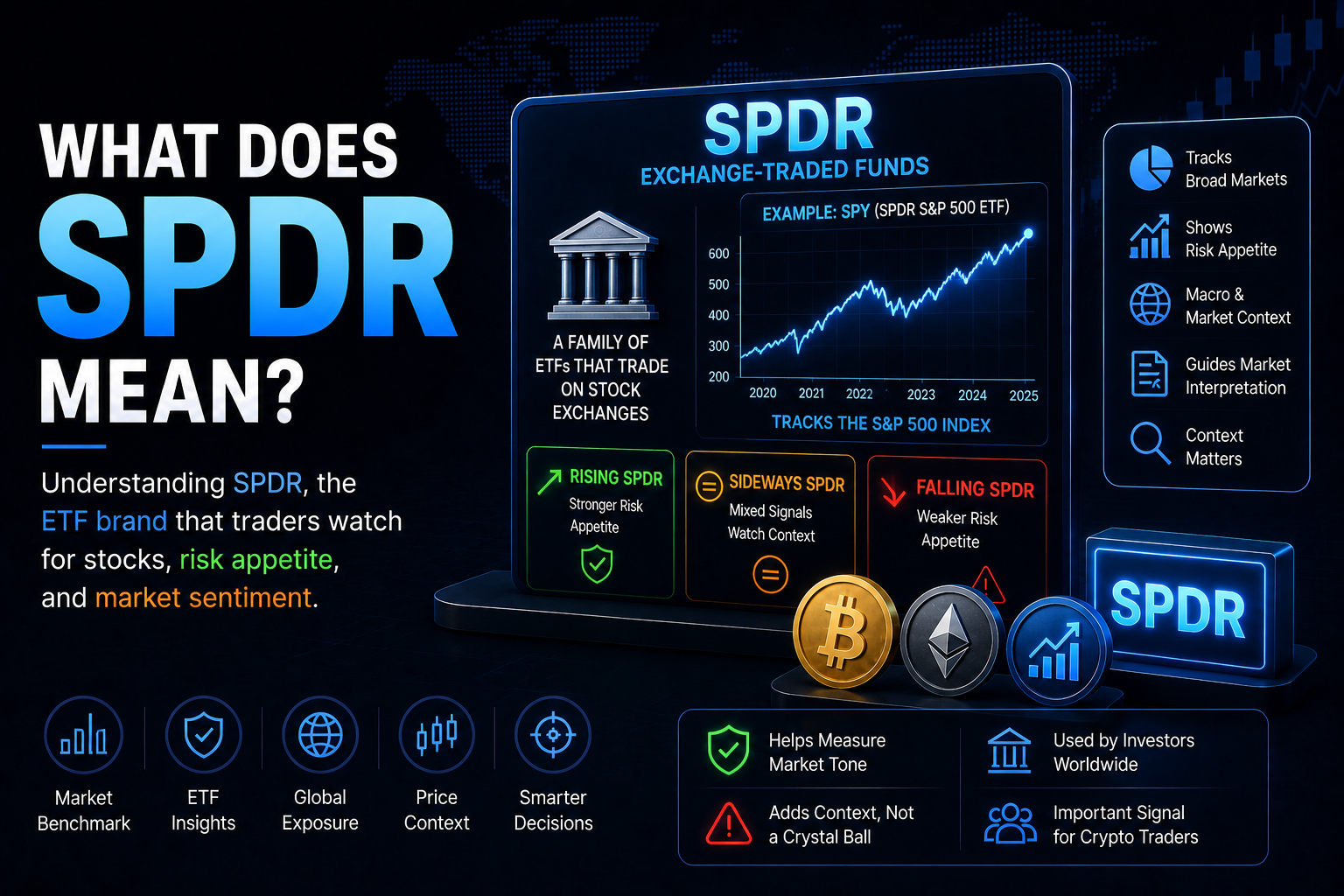
SPDR refers to a family of exchange-traded funds, or ETFs, that trade on stock exchanges. Many traders watch SPDR funds because they can provide a quick view of major stock-market sectors, broad market sentiment, and wider risk appetite.
Simple definition
SPDR stands for Standard & Poor's Depositary Receipts. It was the name of the first ETF created under the brand: the SPDR S&P 500 ETF Trust, launched in 1993 and managed by State Street Global Advisors. This is why traders often pronounce SPDR as “Spider.”
SPDR is now a brand covering many ETFs across sectors, asset classes, and regions, not only the original S&P 500 fund. An ETF is an investment fund that trades during the market day like a stock. Different SPDR funds can track a broad index, a market sector, an asset class, or another defined group of investments.
Why SPDR matters
SPDR ETFs can make it easier for investors to gain exposure to a market segment through one traded product. Broad-market SPDR funds may be used as a reference point for equity-market conditions, while sector-focused funds can show where investor attention is becoming stronger or weaker.
How markets usually read it
Traders may watch the price, volume, and flows of major SPDR ETFs to understand the tone of traditional markets. For example, broad equity ETF activity can provide context about risk appetite, while sector ETF performance may show whether investors are favoring growth-oriented, defensive, financial, industrial, or energy-related companies.
Why it matters for crypto
SPDR is not a crypto product, but it can offer useful context for crypto traders. Bitcoin and other digital assets can sometimes react to changes in equity-market sentiment, interest-rate expectations, the dollar, and broader willingness to hold risk-sensitive assets. SPDR ETF activity may therefore be one input when reading wider market conditions.
SPDR is not a standalone signal
A move in an SPDR ETF does not directly predict what Bitcoin or the crypto market will do. Crypto can respond to asset-specific factors such as ETF flows, regulation, network developments, stablecoin liquidity, or derivatives positioning. SPDR data is most useful as part of a broader cross-market view.
Common signals people watch
- Broad equity-market ETF price action and trading volume
- Strength or weakness across major market sectors
- Whether investors appear to favor growth or defensive assets
- Changes in bond yields, the dollar, and wider risk sentiment
- Whether crypto is moving with or differently from traditional markets
Reading the wider context
SPDR ETFs are one way to observe how investors are positioning across traditional markets. They can add context to a market update, especially when equity performance, sector leadership, or risk appetite may be influencing Bitcoin and crypto sentiment.
However, broad-market context should be compared with crypto-specific information. A strong equity market does not guarantee crypto strength, and a weak equity market does not explain every crypto decline. Liquidity, positioning, institutional flows, and asset-specific developments remain important.
Key takeaway
SPDR refers to a family of ETFs that traders may watch for stock-market context, sector leadership, and broader risk appetite. For crypto, it adds market context rather than acting as a standalone signal.
Comments (0)
Join the discussion
Sign in or create a free account to leave a comment.
No comments yet. Be the first to comment!